
Highlights:
- The US has launched new military strikes following Iranian attacks on maritime vessels in the strategic Strait of Hormuz.
- Iran has retaliated by closing the waterway and attacking US bases in the region, raising tensions significantly.
- Both sides have issued strong warnings, indicating a potential escalation of military actions and broader implications for Middle Eastern stability.
Growing Tensions in the Strait of Hormuz
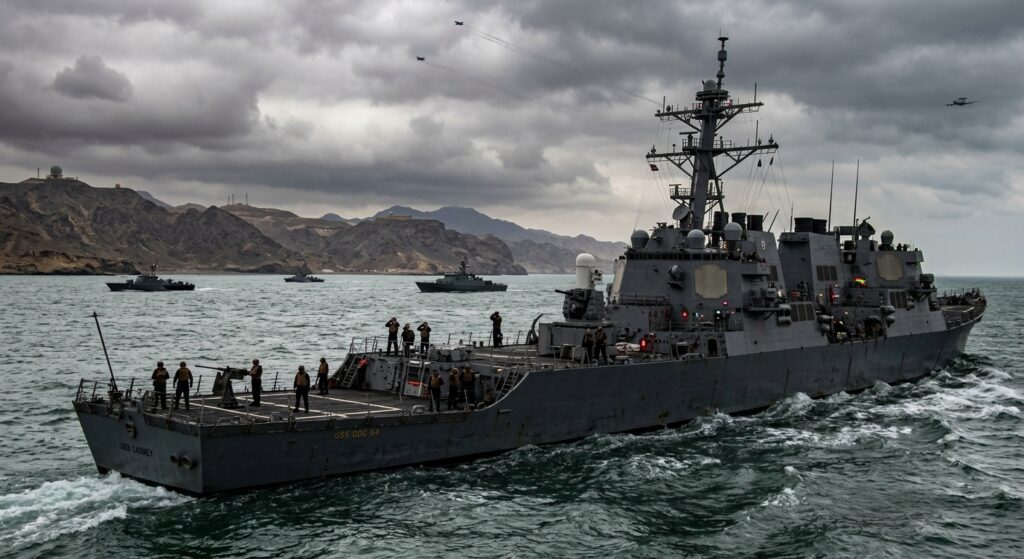
Recent developments in the Strait of Hormuz have escalated tensions between the United States and Iran, marking a significant turning point in their ongoing confrontations. The US initiated a wave of military strikes in response to a string of attacks attributed to Iranian forces targeting ships navigating through this critical maritime corridor. The Strait of Hormuz holds strategic importance as it serves as a vital passage for a substantial share of the world’s oil supply, making the current hostilities a matter of global concern.
Following the US strikes, which aimed at various Iranian military targets, Iran’s Islamic Revolutionary Guard Corps (IRGC) declared the closure of the waterway until further notice, escalating tensions further. This development is not only significant in terms of regional security but also represents a major challenge to international efforts to ensure safe passage for shipping vessels in the Gulf. The situation reflects a broader pattern of aggression that could have far-reaching consequences, particularly for the global energy supply chain.
Clashing Military Interests
The crux of the conflict lies in the series of military actions exchanged between the two nations. Recent incidents saw the IRGC claiming responsibility for the targeting of three commercial tankers, which prompted the US to respond with airstrikes that targeted 140 military sites in Iran. These strikes included missile and drone sites, forcing Iran to defend itself aggressively. US Central Command (Centcom) highlighted the severity of the situation, asserting that Iran has failed to adhere to previous agreements meant to safeguard maritime security.
Moreover, the ongoing military confrontations illustrate the complexities and implications of modern warfare where traditional military power meets geopolitical strategy. Iran has reportedly retaliated by attacking US allied bases in the region, including the Prince Hassan Air Base in Jordan, which highlights the danger of escalating violence. Both nations are now engaged in a dangerous game of military brinkmanship, where the potential for miscalculation remains high.
Implications for Regional Stability
The implications of the current situation are dire, not just for the US and Iran, but for the entire Middle Eastern region. As both nations issue strong warnings of retaliation and escalation, the risk of broader conflict looms large. Increased military engagement could prompt other nations in the region to align with one side or the other, further polarizing an already volatile environment. The closure of the Strait of Hormuz also raises questions about the security of maritime routes critical for the global economy.
In light of these events, diplomatic efforts may become increasingly urgent to prevent an all-out confrontation. Linking dialogue with actions on the ground will be crucial to rebuilding trust and averting further military escalations. The international community, particularly entities focused on security and energy, must monitor the situation closely and encourage diplomatic resolutions rather than military solutions.
In summary, the recent military exchanges between the US and Iran in the Strait of Hormuz present a historical juncture with potential ramifications extending beyond the immediate conflict. As both sides engage in increasingly aggressive posturing, one must consider whether a diplomatic resolution is still feasible. What steps can be taken to de-escalate these tensions? How can global powers balance their interests without exacerbating the situation? The answers may shape the future course of international relations in the region.
Editorial content by Phoenix Riley